The recursive machine
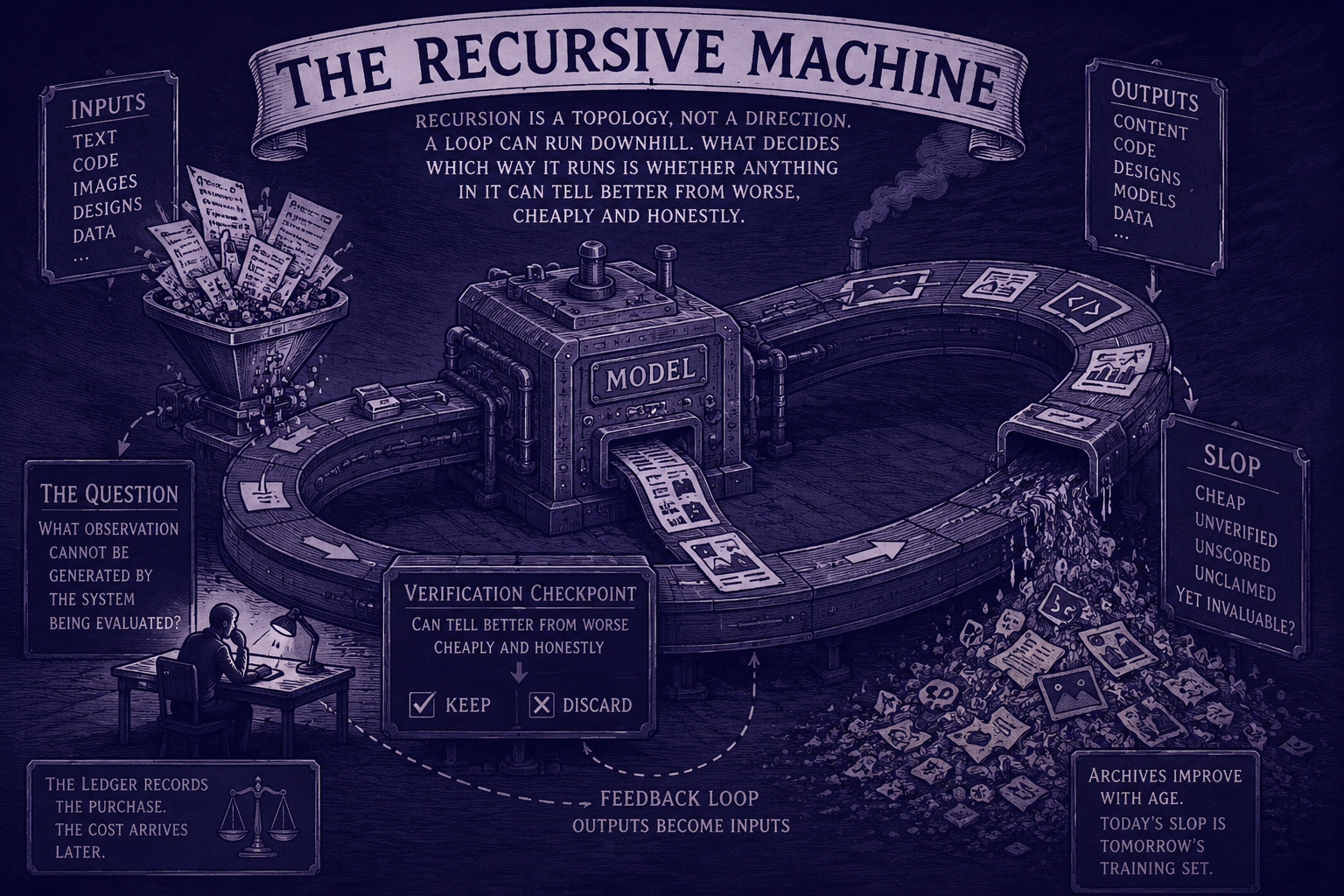
Machines have been improving machines for a long time, quietly, in the places where the improvement could be measured. Compilers are built by compilers. Chips are laid out by tools that will later run on them. What has changed is not the existence of those loops, but their reach: systems now produce the material later systems are trained on, the code they are assembled from, the tests they are judged by, and the experiments that decide what they become.
That moves the interesting question. Not what a model can do for the person using it, but what it produces for its successors, and what is left in the arrangement that can tell whether any of it is an improvement.
A model is a component. The recursive machine is the arrangement in which machines produce the material, code, evaluations and infrastructure that later machines are made from. Its governing property is not power.
Recursion is a topology, not a direction. A loop can compound towards the wrong thing. What decides which way it runs is whether anything in it can tell better from worse, cheaply and honestly.
Disclaimer
The observatory notes the difficulty of its own position. Anything written here about machines producing material for machines is itself material, and stands a fair chance of being read by a crawler some months before it is read by a person. The clerks have agreed not to think about this during working hours.