Legacy systems that refuse to die
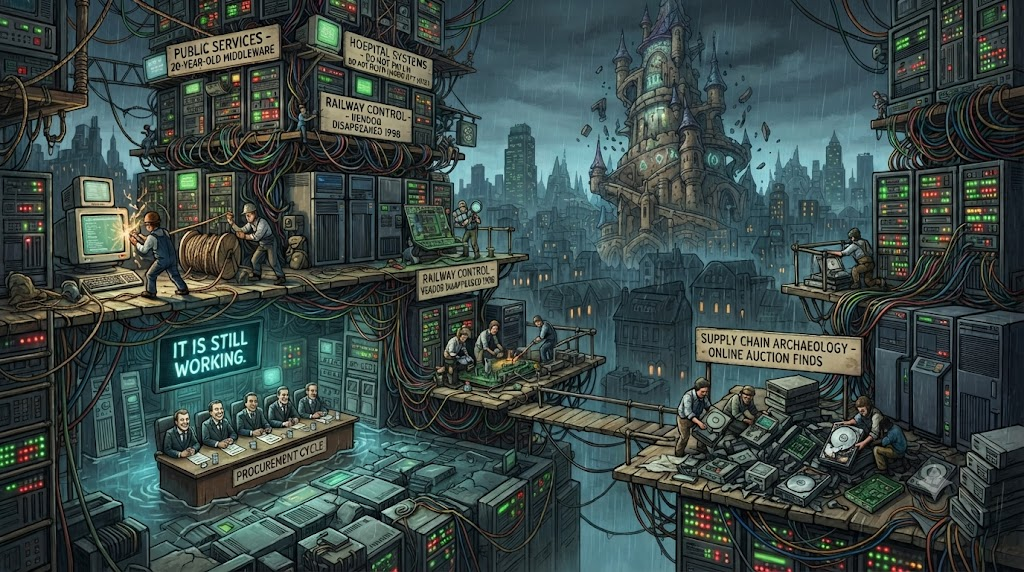
Europe runs on IT infrastructure that groans and creaks like an Ankh-Morpork tenement, held together with twine, optimism, and a few whispered curses. Public services limp along on twenty-year-old middleware, hospitals operate medical devices that cannot be patched without voiding the warranty, and railways and energy systems rely on vendors who disappeared long before GDPR was a twinkle in anyone’s eye.
Governments often favour what they quaintly call strategic delay, pushing modernisation back year after year until the risk becomes existential. Then the bill arrives, with compound interest, and a frown from whoever still believes in paperwork.
The real cost of “if it isn’t broke”
In the public sector, the phrase “it is still working” may be the most expensive lie ever told. A procurement cycle can unfold like a tragicomedy: a system is installed with a five-year support contract, the vendor offers extended support at a premium, then quietly exits the update business altogether. For years the system survives on hope, duct tape, and whispered incantations, until a failure forces an emergency replacement at ten times the planned cost.
The bill is not only financial. An end-of-life system leaves each new vulnerability exposed, which is about as close to a standing invitation as an attacker gets. Compliance can slide into theatre: a regulation requires appropriate technical measures, an organisation ticks the box while running server software old enough to vote, and the breach eventually files the correction. Supply chains sometimes turn into archaeology, with engineers scavenging online auctions for hardware that has not been manufactured in fifteen years. Hospitals really do this.
The refusal to die quietly
Legacy systems do not exist in splendid isolation. Ancient databases feed dozens of other systems, many undocumented, so touching one often brings the whole structure down like a house of cards in an Ankh-Morpork wind. Certification requirements make upgrades trickier still: medical devices, aviation software, and industrial control systems are certified to run on specific versions, and updating one component can trigger recertification of everything at enormous cost. Vendor lock-in compounds the problem. Proprietary formats, closed APIs, and custom protocols mean that when a vendor vanishes, the code stays locked, and migration usually means rebuilding from scratch on a budget that does not exist.
The crisis is also human. The engineers who built these systems retire, replaced by staff versed in JavaScript and cloud platforms rather than VAX assembly or AS/400 RPG. Knowledge dies unless documented, and it is rarely documented. The remaining specialists can command consultancy fees that would make barristers blush, which creates a perverse incentive to keep the obsolete alive: the fewer people who understand a system, the more valuable it is to be one of them, and the more dangerous it is to be the organisation that depends on them.
The tidy version, and the one in production
In the tidy version, every system carries a planned obsolescence date and is replaced when time runs out, with enforced documentation standards, sunset clauses in contracts, and public sector open source mandates ensuring that taxpayer-funded infrastructure belongs to taxpayers. That version calls for procurement teams who understand technology, long-term budgets, technically literate lawyers, regulators with teeth, and politicians willing to challenge incumbent vendors. Such creatures are rarely sighted, even in Ankh-Morpork.
The version in production runs systems until failure, summons emergency consultants at extortionate rates, lets temporary fixes settle into permanence, and expresses surprise at an outcome everyone had privately predicted. A question seldom asked out loud: if this system fails tomorrow, what breaks, for how long, at what cost, and who suffers? Legacy systems will probably not die until they damage something important enough to force change. Until then, we are all passengers.
The clerk’s brief
From the clerks, for the Patrician’s eyes
Compiled July 2026. Entries run newest first. Observations that have stopped being news but not stopped being true are absorbed into the estate ledger at the end. Nothing below requires his Lordship’s action, which is precisely why it requires his attention.
February 2026: The debt is now blocking the future as well as the past
Research published by ResultSense in February 2026 finds that 84 per cent of UK government organisations carry Windows technical debt, that three in five say legacy systems are already blocking AI adoption, and that 45 per cent report diverting innovation budgets to keep ageing infrastructure alive. The clerks observe that the money meant to build the future is being spent keeping the past on life support, and that this is no longer a figure of speech but a line item.
November 2025: Germany’s federal office names the debt directly
The BSI’s report on the state of IT security in Germany, published November 2025, counts an average of 119 new vulnerabilities daily, roughly 24 per cent more than the year before, and names technical debts a central cause: systems grown over years without unified security concepts, outdated software, poorly configured services, unnecessarily exposed components. When a federal security authority adopts the accountants’ vocabulary, the clerks take it as a sign the problem has stopped being deniable.
October 2025: Windows 10 reaches end of support, and Europe negotiates a stay
Microsoft ended support for Windows 10 in October 2025 with many of Europe’s desktops still running it. Euroconsumers had accused Microsoft of planned obsolescence in June 2025, and by September 2025 had extracted a no-cost year of extended security updates for consumers in the European Economic Area, free of the backup-and-rewards conditions applied elsewhere, though a Microsoft account is still required. The reprieve runs to October 2026. The clerks note that a continent negotiating a one-year stay of execution for its own desktop estate is not, strictly speaking, a modernisation strategy.
June 2025: Denmark begins the long walk out
Denmark’s Ministry of Digitalisation announced in June 2025 that it would replace Microsoft Office with LibreOffice, following the municipalities of Copenhagen and Aarhus, in the same week the German state of Schleswig-Holstein confirmed its own migration; by July 2025 the Document Foundation reported half the ministry’s staff moving over the summer. The minister’s stated reason was not cost but dependence: we must never make ourselves so dependent on so few that we can no longer act freely. The clerks read this as governments beginning to treat vendor dependence itself as a species of legacy debt, and note that the walk out is measured in years rather than announcements.
January 2025: The United Kingdom counts its estate and finds more of it
The UK government’s State of digital government review, published January 2025, classifies 28 per cent of central government systems as legacy, up from 26 per cent in 2023, with rates in individual NHS trusts and police forces ranging from 10 to around 70 per cent, and every organisation profiled reporting insufficient funding to manage the debt. The direction is worth more attention than the number: the estate appears to be ageing faster than it is being replaced, and there are now official figures saying so.
The estate ledger
The pattern the clerks keep returning to has three parts. First, the estates are now measured. Since January 2025 the United Kingdom publishes legacy percentages the way other departments publish unemployment figures, and each measurement so far has been worse than the last. Second, the timetables do not align. Vendor support ends on commercial schedules, replacement is funded on political ones, and the gap between the two is where the debt lives; the Windows 10 affair of October 2025 was only the latest staging of a play Europe has watched at end-of-support dates since Windows XP. Third, the exits are real but slow. The Danish and north German migrations that began in mid-2025 are measured in years, and an organisation halfway out of a dependency runs two estates at once, which is more debt, not less, until it is finished.
None of this is new. The novelty, as of 2025 and 2026, is governments saying it in official documents.